
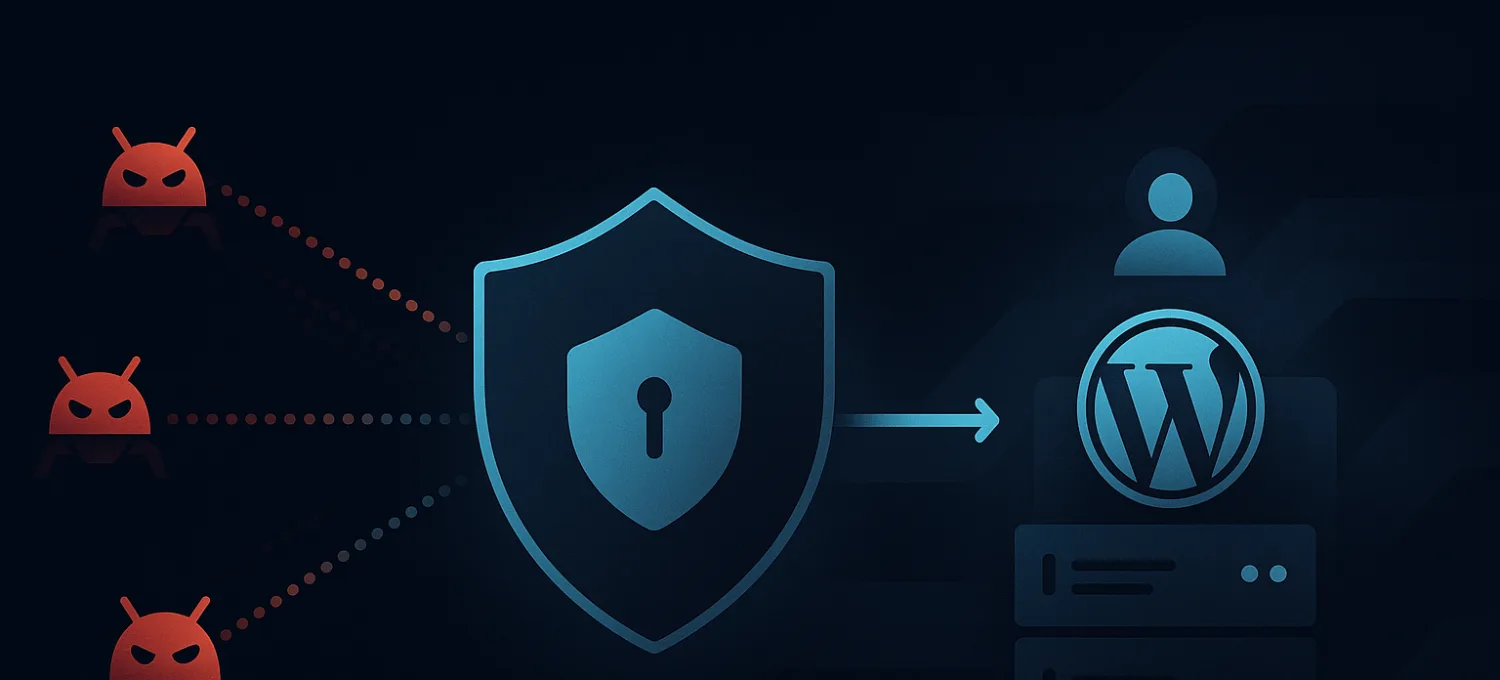
Bots do not need to take your WordPress site offline to become a problem.
They just need to keep hitting the wrong paths often enough that PHP workers, database queries, and uncached requests get spent on visitors who were never going to buy, read, or sign up.
That is why "blocking bots" on WordPress is not really about vanity traffic numbers. It is about protecting the expensive parts of the site before bad traffic turns performance and stability into an operations problem.
Why Bot Traffic Hurts WordPress So Easily
WordPress is especially vulnerable to noisy automation because many important routes are dynamic:
- login
- admin
- search
- account pages
- forms
- cart and checkout
- plugin-generated AJAX or API paths
Even low-grade automated traffic can force WordPress to do real work on those routes. That means your site can stay technically online while still feeling slow or unreliable for legitimate users.
Start by Identifying What Kind of Bots You Mean
Not every bot should be blocked.
The useful split is:
- legitimate crawlers you want, like search engines
- neutral automation, like uptime probes or integrations
- abusive bots scraping, probing, brute-forcing, or hammering expensive paths
If you treat them all the same, you either block something useful or leave the harmful traffic too much room.
WordPress Plugins Are Not the Best First Barrier
Many site owners try to solve bot abuse entirely inside WordPress with security plugins.
That helps in some cases, but it has an obvious limitation: by the time the plugin evaluates the request, the request has already reached the application. On a busy site, that means PHP and database resources are already being spent.
For simple cases, plugin-level controls are fine. For repeated abuse on dynamic routes, edge-side filtering is usually the stronger answer because it can stop junk traffic before WordPress wakes up.
Which Routes Usually Need Protection First
If your goal is to block bots without breaking the site, start with the paths where automation is most expensive:
/wp-login.php/wp-admin/- search and filter endpoints
- account creation and password reset
- cart and checkout
- exposed plugin routes
- XML-RPC if it is still enabled and not required
These are the routes where bot traffic usually hurts performance and user experience fastest.
What Actually Works
The practical playbook is usually a combination of:
- rate limits on login and admin paths
- bot/challenge handling where browser-based proof is safe
- route-aware caching where applicable
- strict handling for machine-to-machine traffic like webhooks
- narrow allow rules for trusted integrations
The key is not “more rules.” It is better placement and better scope.
If your bot controls are too broad, real users get blocked. If they are too weak, the origin keeps doing unnecessary work.
Signs You Are Blocking Too Late
If a site still shows these symptoms, the bot problem may be reaching origin before it is being handled:
- slow login even when the homepage is fine
- search or filter latency under normal traffic
- admin lag during bot bursts
- cart or checkout instability without a full outage
- high origin load that does not match real-user growth
That usually means the question is no longer “should we block bots?” It is “why are these requests still touching WordPress at all?”
A Safer Blocking Strategy
The safest approach is progressive:
- identify the abusive route
- confirm the request pattern in logs
- add the narrowest useful control
- verify it does not break real users or trusted integrations
- tighten only where the route still needs it
This avoids the common mistake of turning a bot problem into a customer problem.
The Goal Is Less Waste
Blocking bots on WordPress is ultimately about resource protection.
The best outcome is not just fewer junk hits in a dashboard. It is a site that spends less time serving bad traffic and more time serving real visitors on the routes that matter.
If WordPress is still doing expensive work for the wrong clients, the bot problem is not really solved yet.